|
|

|
|
|
|
|
|
|
Facility News
Happy New Year to you all 🥳! I hope it brings you everything you are hoping for and some more !
|
|
Is the new year a way for you to try some new habits and resolution ? Is one of them to produce for the best flow panel ever ? Well this month, the FCF Team got you covered and bring you some ideas to pimp up that panel and make it even nicer !
|
|
Athanasios Kouklas won the mug this month, Congratulations to you ! Please come by to our office at the SE-C Biopole to pick it up !
|
New Year but same Quiz tradition ! Please try to answer it and get a chance to win the mug of the month ! Good luck to you all !
|
|

|
|
|
FACS Tips
|
|
|
Pimp Your Panel
|
I’ve recently been to the AFC Cytometry 2025, The French Flow Cytometry Meeting in Dijon. At this conference, besides the new flow cytometry analyzers and sorters, I’ve noticed a trend that keeps on going for a couple of years now, the rise of new, improved and fine-tuned fluorochromes. It’s true that new technologies do bring exciting new perspectives and freshly released machines can often provide the needed push to explore previously impossible topics. Yet, our reagents and consumables do need to keep up and match the potential of those new equipment.
|
I will highlight the new tricks those fluorochromes are using to help you get the most of your flow experiments !
|
Improving on known dyes
By now, many of our users have tried and often adopted spectral flow cytometry. It can easily accommodate for panels that works on conventional flow cytometry and makes it relatively easy to add new fluorochromes or even add two panels together as one.
|
But as we starting to increase the panel to 20+ colors, it becomes more challenging to balance the different fluorochromes without compromising the quality of the unmixing. One of the main reasons is that we will usually work with the fluorochromes that always worked for us in the past with conventional flow cytometry. Dyes like PerCP-Cy5.5 (PCP5.5) were perfectly fine when we would use conventional Long Pass and Band Pass Filters to check a fraction of their spectral emissions.
|
|
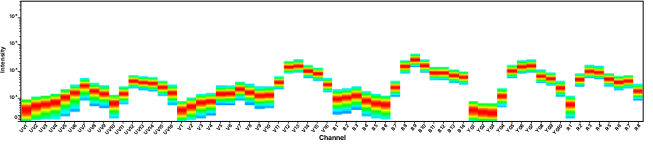
It becomes another story when we are working with spectral flow cytometry, nothing is hidden and we have to deal with the whole spectral signature of the dyes we work with. In the case of PCP5.5, it can bring more complications to your unmixing. Indeed, let’s look at the spectral signature of PerCP-Cy5.5 :
|
|
|
|
|
PerCP-Cy5.5 main channel and brightest peak is B9 but we can now also see that it has an important cross laser excitation in the violet and yellow green laser. As a consequence, it will often bring important spillover spread in the violet and yellow green channels.
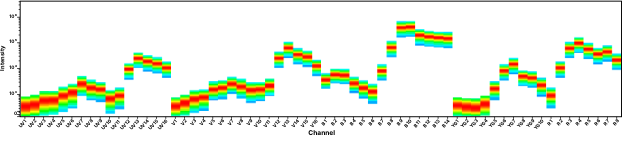
An interesting alternative to PCPCy5.5 could be BD Real Blue 705 (RB705). As you can see from the signature below :
|
|
|
|
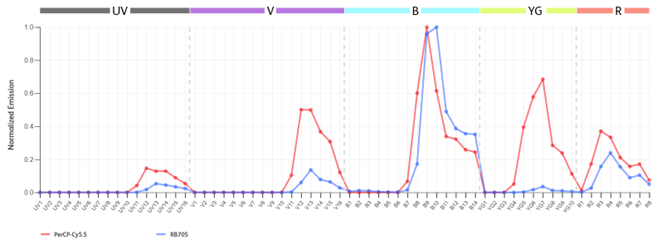
The main channel moves to B10 and the cross lasers excitation is much reduced. If we compare and normalized both signatures, we can appreciate the improvement :
|
|
|
|
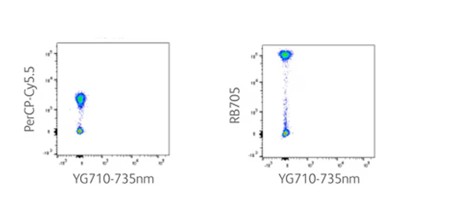
The implication for your experiment is that you can expect a RB705 to be not only brighter but also to have less spillover spreading with dyes like PE-Cy5.5 or BV711. As a an example below, you can see that staining using Human CD4 has an improved resolution without any spillover spreading increase.
|
|
|
Human whole blood was stained with PerCP-Cy5.5 or RB705 Human CD4 (clone SK3), acquired on a BD FACSymphony™ A5 SE Cell Analyzer and compensated with FlowJo™ Software. Note that spillover spread is a function of reagent brightness and antigen density, similar spillover spreading observed at higher brightness indicates lower spillover spread (more details)
|
The dyes that take a spot not usually used
|
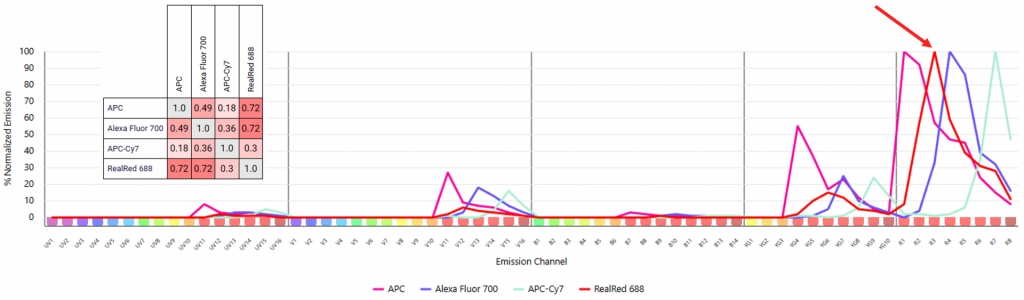
Another interesting series of dyes that are being released are fluorochromes that can take a spot that is either only available or strongly optimized for spectral flow cytometry. As an example, Real Read 688 (RR688) works perfectly in a red color heavy panel on a spectral machine. As you can see below :
|
|
|
It can place itself in R3 which usually not taken by commonly used dyes, offering an alternative for your panel design. Additionally, this dye also benefits from a low cross laser excitation. Other dyes in this category would be RB744 that uses B14 or cFluor V515 that places itself in V6.
|
It remains important to respect the rules of panel design as we talked about in previous newsletters but it does offer much needed options !
|
The dyes that resist everything
One last aspect of a panel design that is often forgotten is the importance of choosing the right dye for intracellular and intranuclear staining. To go through the cell or nuclei membrane, fixation and permeabilization is required and that would often affect the stability of your fluorochrome. For a long time, small molecule fluorescent dyes like Alexa Fluors were favored for this task as they tend to be more resistant to fixation. Alexa Fluor 488 would be preferred to FITC and Alexa Fluor 647 chosen over APC. One of the caveat is that the Alexa Fluor can be pretty limited in choices and in brightness.
|
|
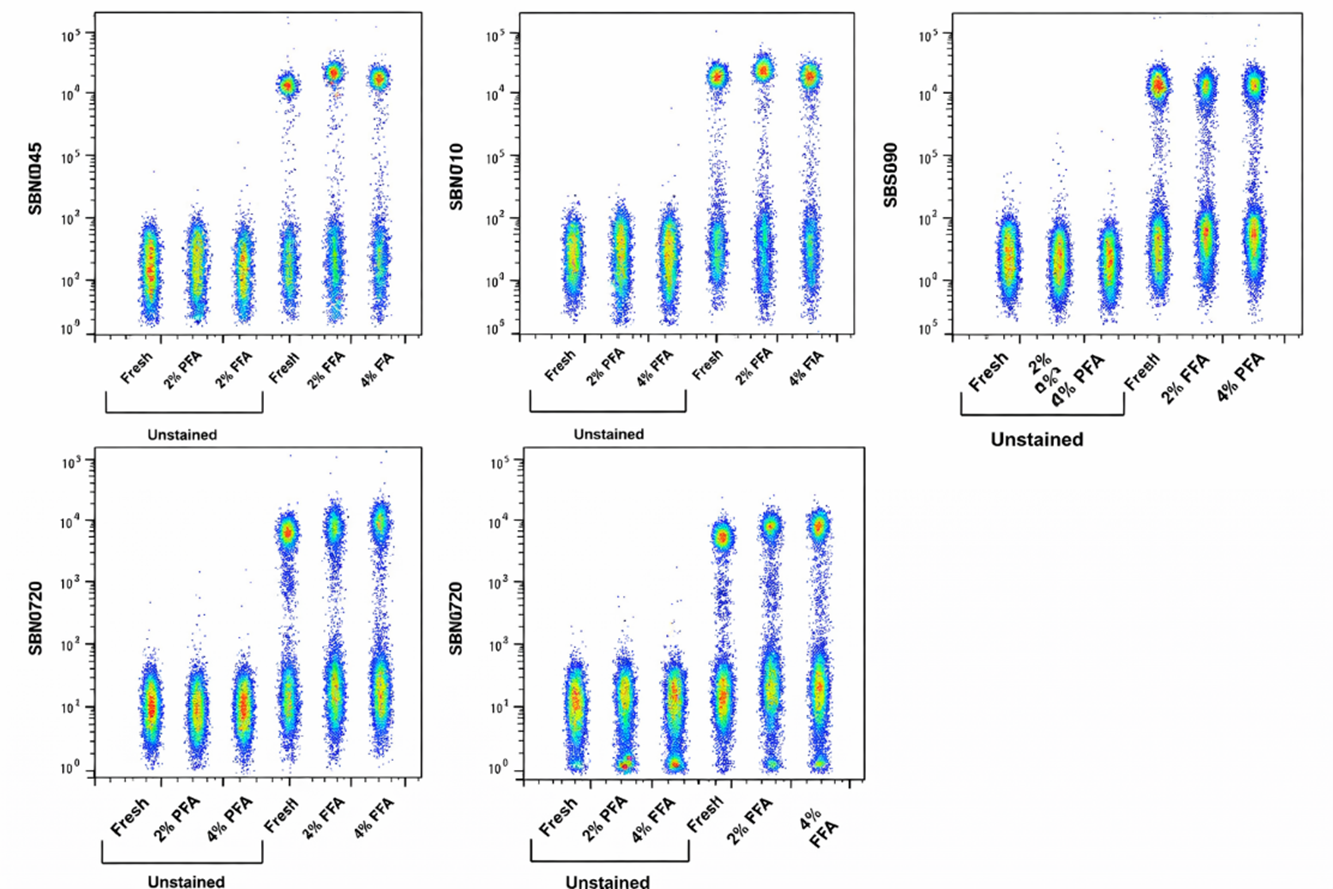
This is what the StarBright Dyes aim to fix. Although large, they can be fixed in formaldehyde-based fixatives with barely any impact on their brightness.
|
|
|
Effect of fixation with formaldehyde-based fixative on dye performance. Human peripheral blood was single-stained with CD4 conjugated to SBUV665, SBV710, SBB580, SBY720, or SBR775. After washing, the samples were incubated in PBS, 2% or 4% PFA for 20 min at room temperature prior to acquisition. Data were collected on a ZE5 Cell Analyzer.
|
|
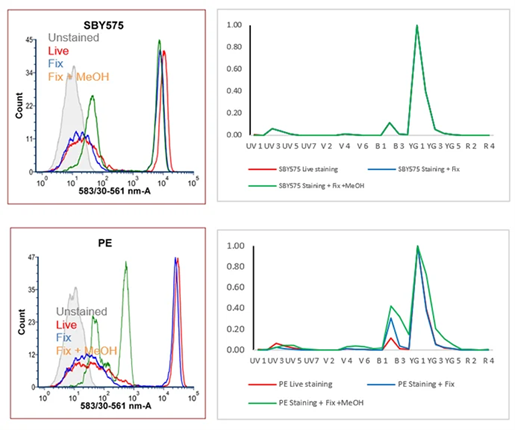
Those dyes are also able to resists harsher conditions like alcohol-based buffers that are required for phosphoflow applications. Below you can see how StarBright Yellow 575, an equivalent to PE, can go through different treatment steps and maintain its brightness when PE is rapidly degraded and becomes more susceptible to cross laser excitation by the 488 nm laser.
|
|
|
Effect of fixatives on StarBright Yellow Dye–conjugated antibodies compared to PE and PE-tandems. Human PBMCs were stained with mouse anti-human CD4 and acquired on a ZE5 Cell Analyzer before fixation, after fixation in a PFA-based fixation buffer (00-8222-49, Thermo Fisher Scientific) for 15 min, and after fixation in a PFA-based fixation buffer followed by incubation in 100% MeOH for 30 min. Cells were gated on live, single cell lymphocytes. Histogram overlays and the signal from CD4-positive cells in each filter are shown. (more details)
|
Although you should always make a test beforehand to make sure your staining remain stable through your different protocol steps, it offers a better chance for it to succeed !
|
Final Words
|
In conclusion, now more than ever, we have a large array of fluorochromes that we can use to how advantage based on our scientific question, study model and technical limitations. Investing in those new dyes has an undeniable cost but it can also provide a much clearer resolution to your markers and step up your panel quality. In any case, feel free to come talk to us if you are curious about fine tuning your panels !
|
|
|
|
|