|
|

|
|
|
|
|
|
|
Facility News
Days are getting longer and we're almost through with winter ❄️ but I am certain this month will still be full of smooth ski slopes and fondues for you ! Enjoy it as much as the smooth flow experiments at the FCF (at least, that's what we try to provide !).
|
This month, we're making a quick overview of our Cytek machines and what they can offer to you. Importantly, our Aurora CS is now available to use at the SE-C biopole sites so if you are interested, please get in contact with the FCF staff !
|
|
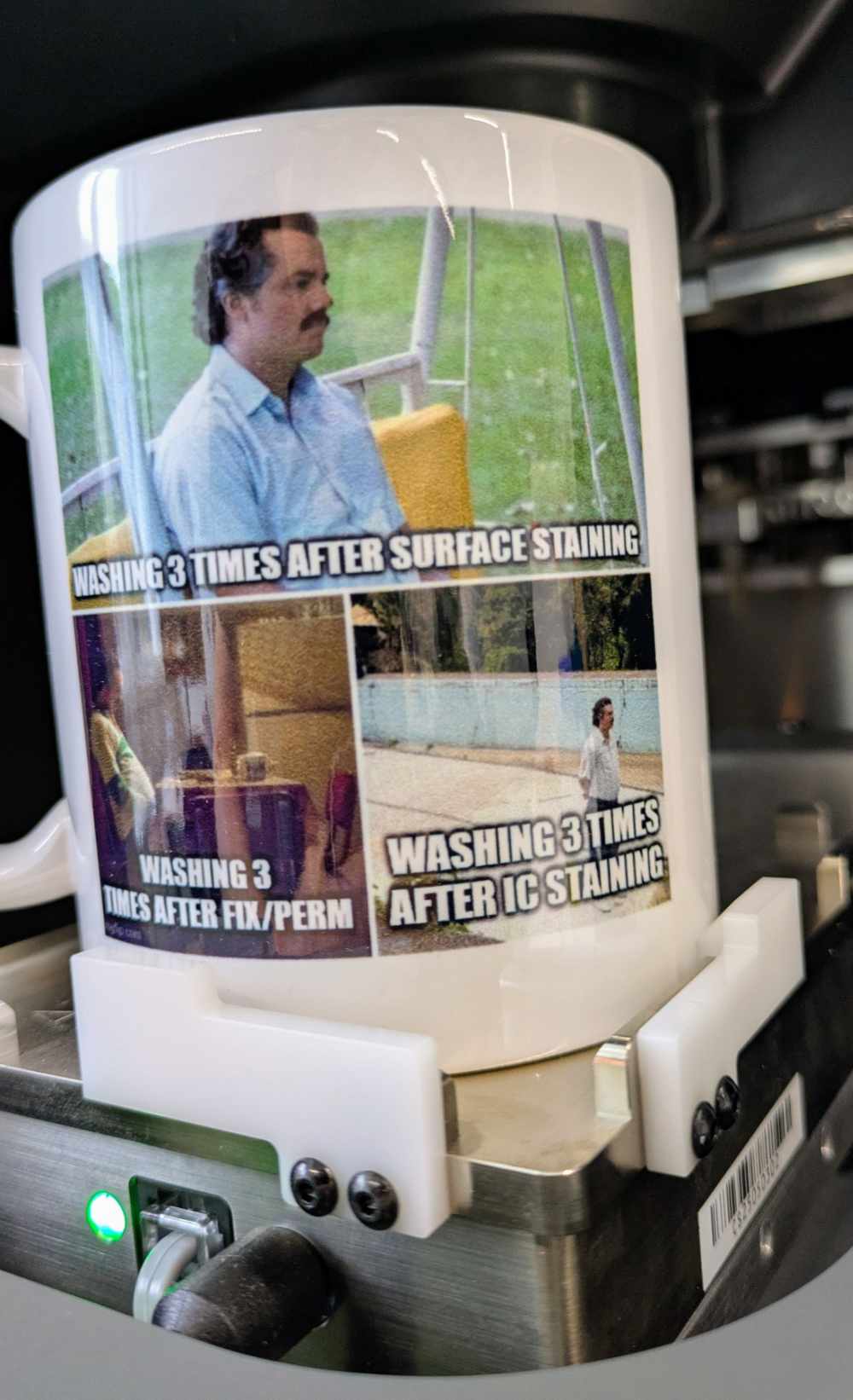
Alexandre Dumez won the mug this month, Congratulations to you ! Please come by to our office at the SE-C Biopole to pick it up !
|
|
|
New Year but same Quiz tradition ! Please try to answer it and get a chance to win this mug of the month ! Good luck to you all !
|
|
|
|
FACS Tips
|
|
|
Aurora Borealis (Localized Entirely in the FCF)
|
If you haven’t noticed, new members have joined our spectral family over the past few months. We have installed two Aurora Evos, the next generation of the Aurora spectral analyzer, as well as the Aurora CS, Cytek’s spectral sorting instrument.
|
With these three additions, together with our previously installed three Auroras and the ImageStream, we now are among the top three highest number of Cytek instruments in Switzerland
|
While these new instruments will feel familiar to existing Aurora users in terms of performance and interface, they significantly extend our capabilities. In this newsletter, I’ll highlight what’s new and how these features may benefit your experiments.
|
Aurora Evo
|
In many ways, this machine is identical to the existing Auroras. Any experiment already prepared on any of our existing machines can quite easily be transferred to either of these two new machines (with new single stains recorded of course).
|
|
|
|
|
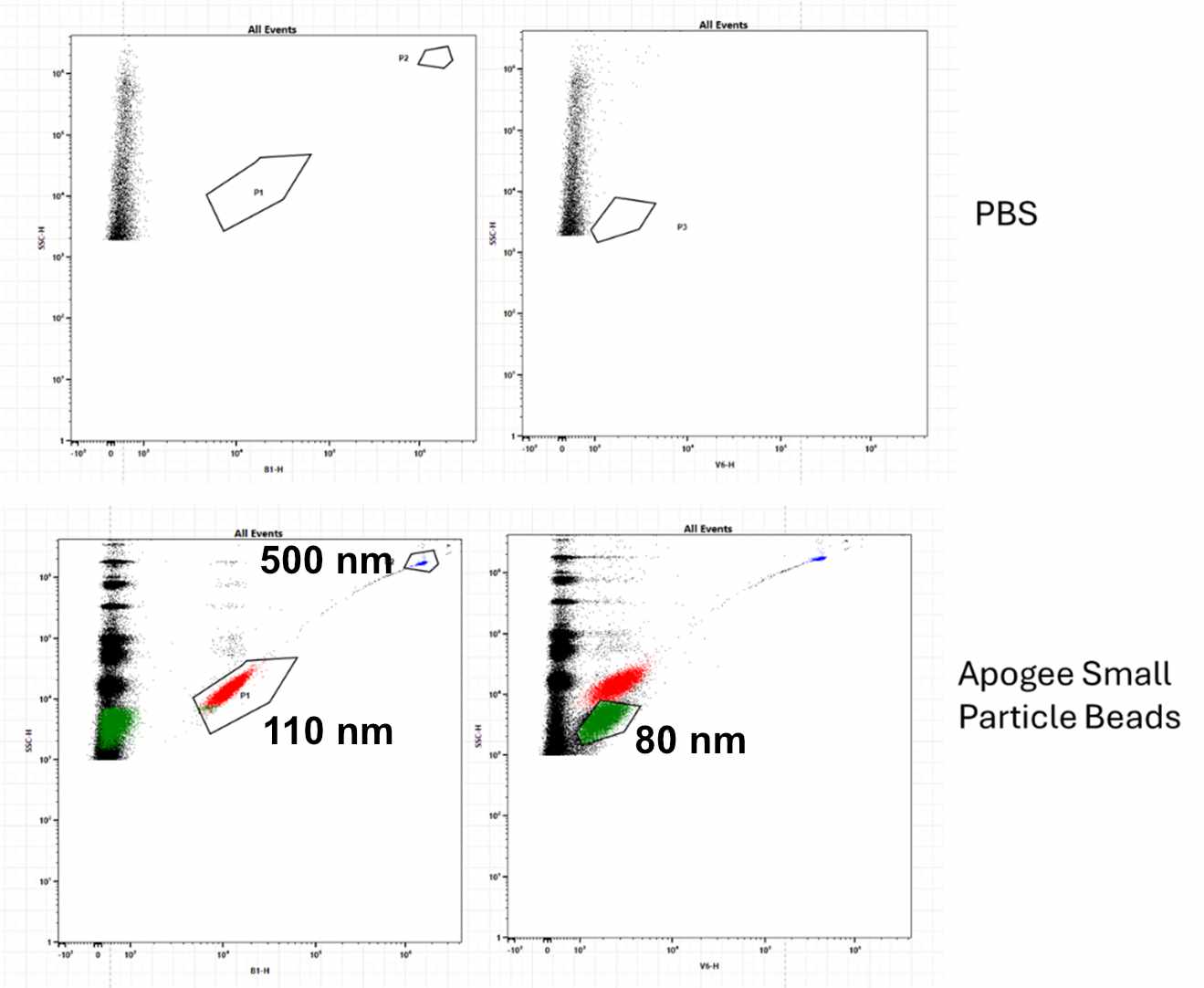
One notable addition is the ESP feature, already available on the Aurora 3 installed at the Agora. This is particularly valuable for small particle experiments, as demonstrated by bead samples run during recent training sessions. Cytek advertises resolution of beads down to 70 nm separated from background with the ESP, and 90 nm without ESP. Because small particle work requires additional preparation, we strongly recommend contacting us before attempting these experiments so we can guide you through the necessary steps.
|
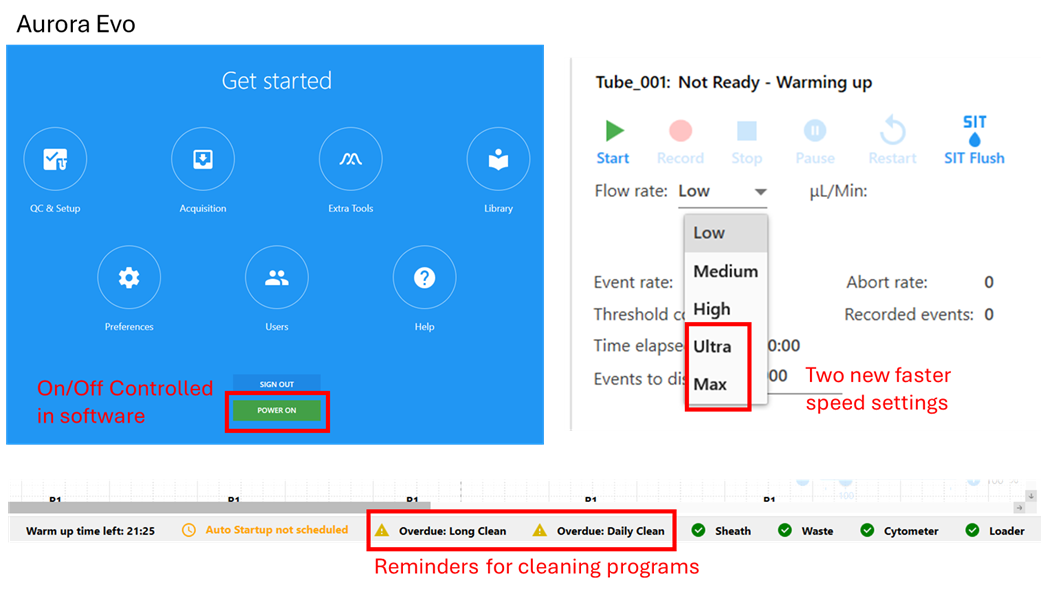
The Evo also introduces automated startup functionality. While we are still determining the best way to utilize this feature operationally, it allows the instrument to be scheduled to power on at specific times (e.g., 9:00 AM) so lasers are fully warmed up ahead of use.
|
|
More relevant for most users is the ability to schedule automated cleaning and shutdown during long experiments, like what is currently available on the CytoFLEX LX instruments.
|
|
|
The machine will ask and provide warning for users to perform the Long Clean, however we would prefer that users maintain our current cleaning protocol and ignore this.
|
The Daily Clean will replace the fluidics shutdown protocol. This can also be done with plates you just need to ensure enough wells are filled to meet the volume requirements for the procedure however this will be laid out in the script in SpectroFlo software. While less user-facing, the updated QC system provides us with more detailed information about instrument sensitivity and responsiveness, allowing us to ensure optimal performance over time.
|
Finally, the Evo introduces two additional acquisition speed settings beyond those available on earlier Aurora models: Ultra and Max. While these can be of use to users, it is important to remember that data gathered quickly is not necessarily data gathered well, and that there will be a trade off in quality and resolution for samples run at max speed. For some experiments this may not matter. For others this could be problematic. For instance, running at Max speed can have influences on how the FSC is displayed.
|
Aurora CS
The value proposition of the Aurora CS is straightforward:
|
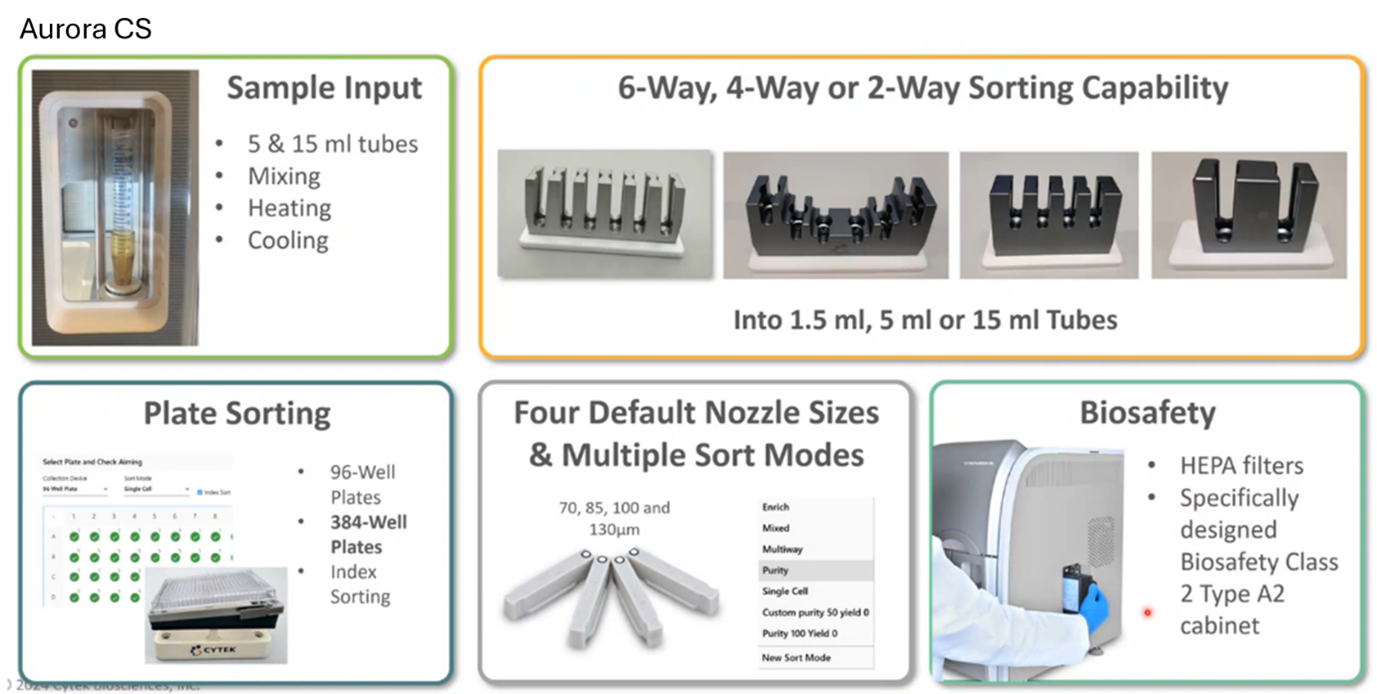
Cells you can identify on an Aurora analyzer can now be sorted on a spectral platform.
|
|
All the time and effort invested in building high-quality spectral panels can now be carried directly into sorting experiments by transferring those experiments to the Aurora CS. And we get to keep the added benefits of spectral analysis such as autofluorescence subtraction.
|
|
|
|
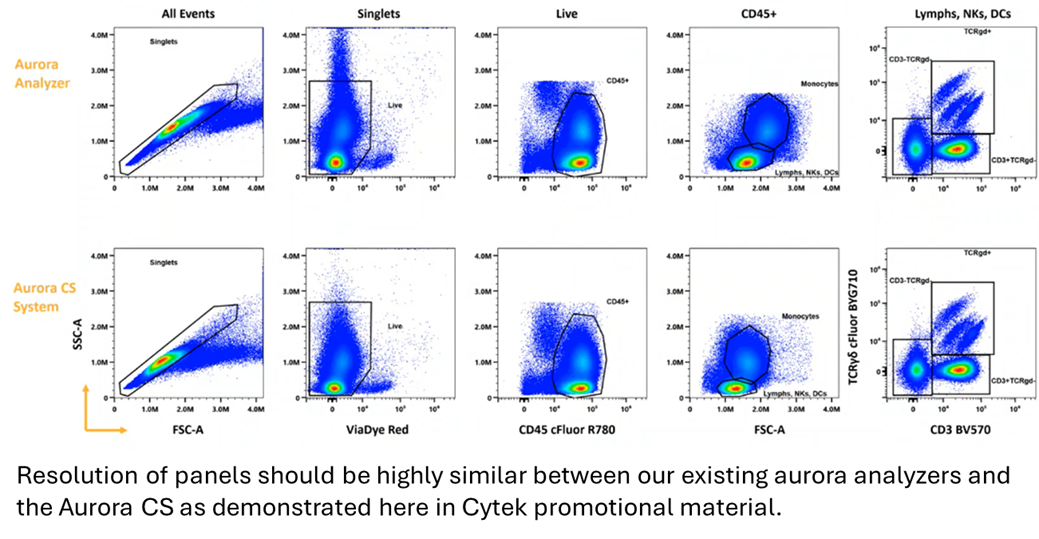
Like our existing Aria sorters, the Aurora CS supports 70, 85, 100, and 130 µm nozzles, and the detector configuration is identical to the Aurora analyzers. However, because the flow chamber assembly differs from that of an analyzer, some fluorophore resolution may be slightly reduced due to the physical requirements of sorting.
|
|
|
Compared to the S8, our other spectral sorting instrument, the Aurora CS does not provide images. However, thanks to the presence of many Aurora instruments across our two sites, there are lots of opportunities to prepare ahead of time to ensure your sorting panels are working. We also have the added benefit of being able to work with the superior SpectroFlo software of the Aurora, which makes it easier to make small adjustments and fix unmixing problems.
|
|
One additional difference between the S8 and Aurora CS is also the fact that the Aurora CS can be run in a conventional mode, similar to what is done on the Aria. This could be advantageous for better synchronization of simpler bulk sorting with our two Aria sorters at the Biopole.
|
|
Aurora Harmonization
Harmonization across Aurora instruments has long been a topic of discussion. Unfortunately, there is no truly simple way to achieve identical resolution across different machines. While 8-peak bead controls can be used for standardization, this approach is not always straightforward.
|
The good news is that experiment templates can be exported and shared across instruments. Based on our experience, we believe the most reliable approach for running the same experiment across multiple Auroras is to invest time in preparing high-quality single-stain controls.
|
- Use cells for single stains whenever possible! They do not need to be from the exact experimental condition or tumor type, as long as they reflect the correct fluorescence. Spleen single stains should outperform more complex autofluorescent heavy tumor single stains even for tumor samples. However, individual experiment testing will be necessary.
- Beads can work well but not always, make sure to test your beads before or consider trying multiple brands to find one that works best.
- If specific treatments are required to achieve proper staining, include them.
- Run these optimized single stains on all instruments you intend to use on the same day they are prepared.
Well-prepared single stains can be used for extended periods, whereas unstained and live/dead controls must be prepared fresh for each experiment. This approach can significantly improve unmixing quality and save time when sample availability is limited.
|
Conclusion
With the installation of these three additional Aurora instruments, we expect a significant reduction in booking pressure and greater flexibility for users to schedule experiments at times that suit them. If you are planning a new experiment on an Aurora platform, we recommend booking Aurora 4 or 5, which currently have excellent availability.
|
If you would like assistance getting started on an Aurora, designing a spectral panel, or planning a future sorting experiment, please don’t hesitate to reach out to the FCF staff, we’re happy to help.
|
|
|
|
|