|
|

|
|
|
|
|
|
|
Facility News
|
We're soon hitting mid-July and you know what it means, a well deserved break for all ! So as you are enjoying your holidays☀️ and take a break from science, don't forget your favorite FCF team and feel free to share pictures📷of your travels and explorations with us !
|
|
In this month FACS Tips, Kevin talk about a phenomenon that some of you might have experienced on the LSRIIs and Fortessa, the SIT backflow. We've tried to figure out how damaging it can be to your samples so please check it out !
|
|
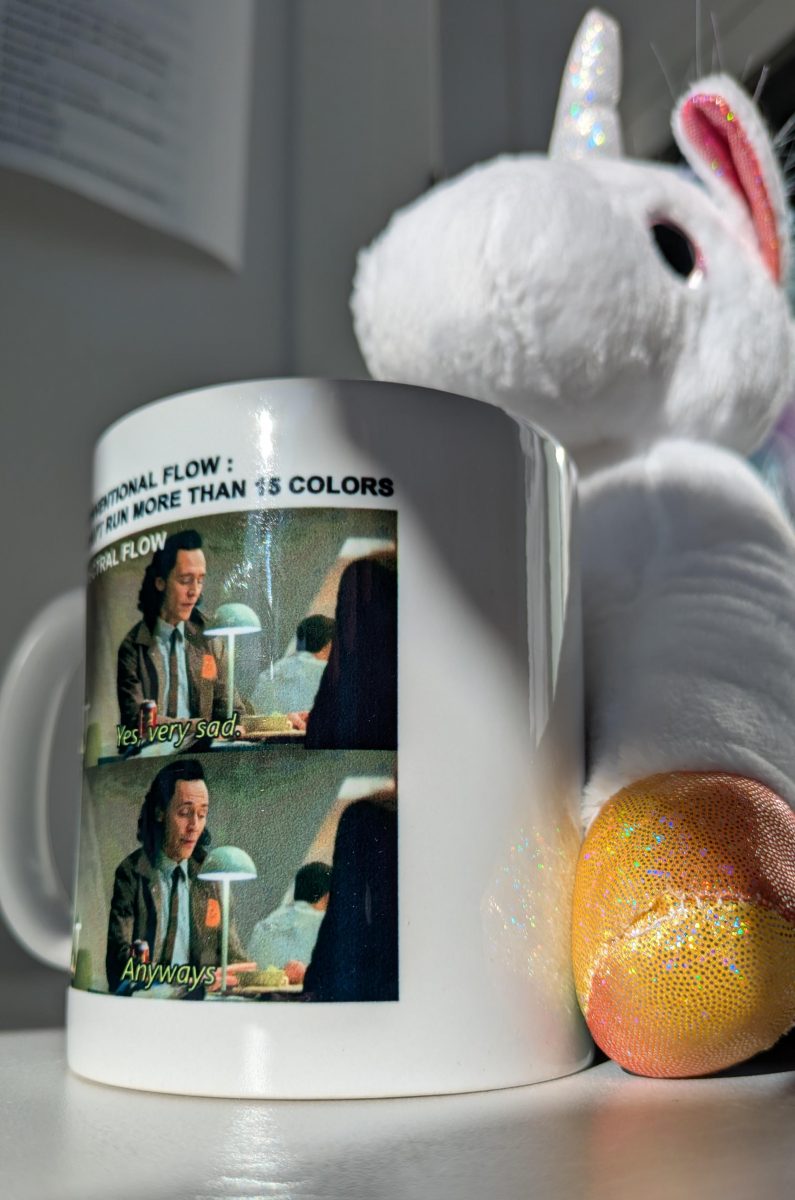
Yi-Hao Wang won the mug this month, Congratulations to you !
|
|
|
Each month, we will ask you 3 questions about the newsletter topic. If you win, you can enter the lottery to win a unique mug designed by the FCF team !
Please take few minutes to answer the quiz HERE.
|
|
|
|
FACS Tips
|
SIP Happens : The Backflow Chronicles
|
Our samples are precious and deserve the utmost care to avoid accidentally introducing anything that could compromise their integrity. Few things are more disheartening than arriving at the cytometer only to find a tube full of dead cells.
|
|
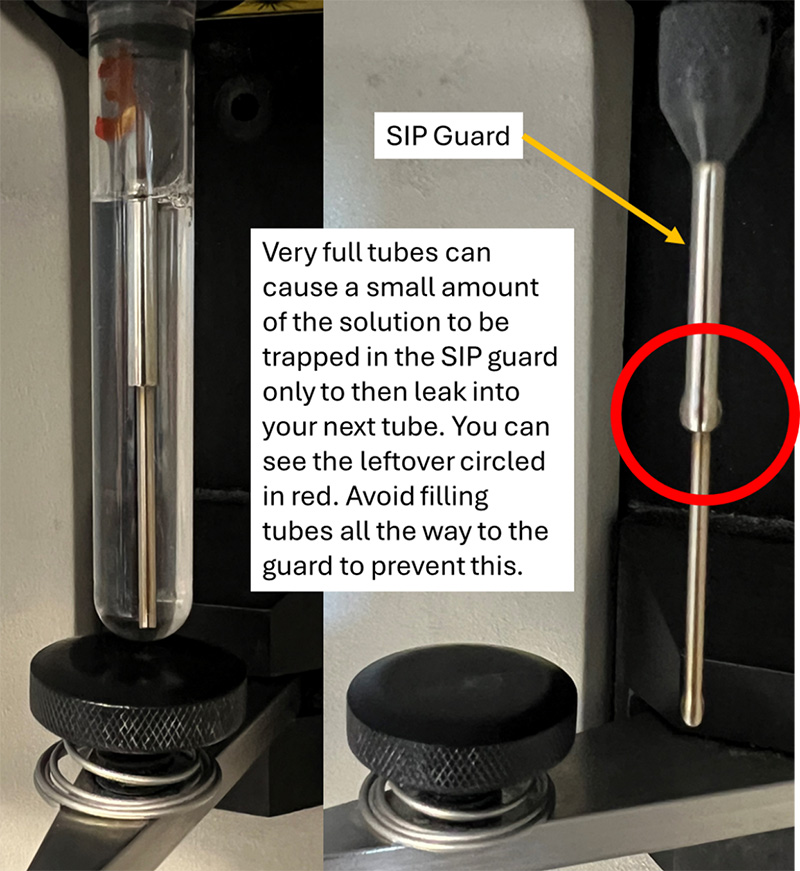
Unfortunately, cytometers themselves can sometimes make sample preservation challenging. Running the cleaning fluids along with the sheath fluid is necessary, but it also increases the risk of contamination. For example, the SIP guards on BD instruments can retain a small amount of fluid after a very full tube is loaded. This residual liquid can drip back into the next sample. Most machines are capable of some form of accidental backflushing. On the Aurora, for instance, we’ve observed occasional dripping from the SIP retraction area during a SIT flush. Despite our best efforts, completely isolating samples from any residual cleaning or sheath fluids can be difficult.
|
|
|
This lead to an argument we had recently in the facility as to how much, and how quickly, MilliQ water could kill cells if it was to be accidentally added to a tube before running.
|
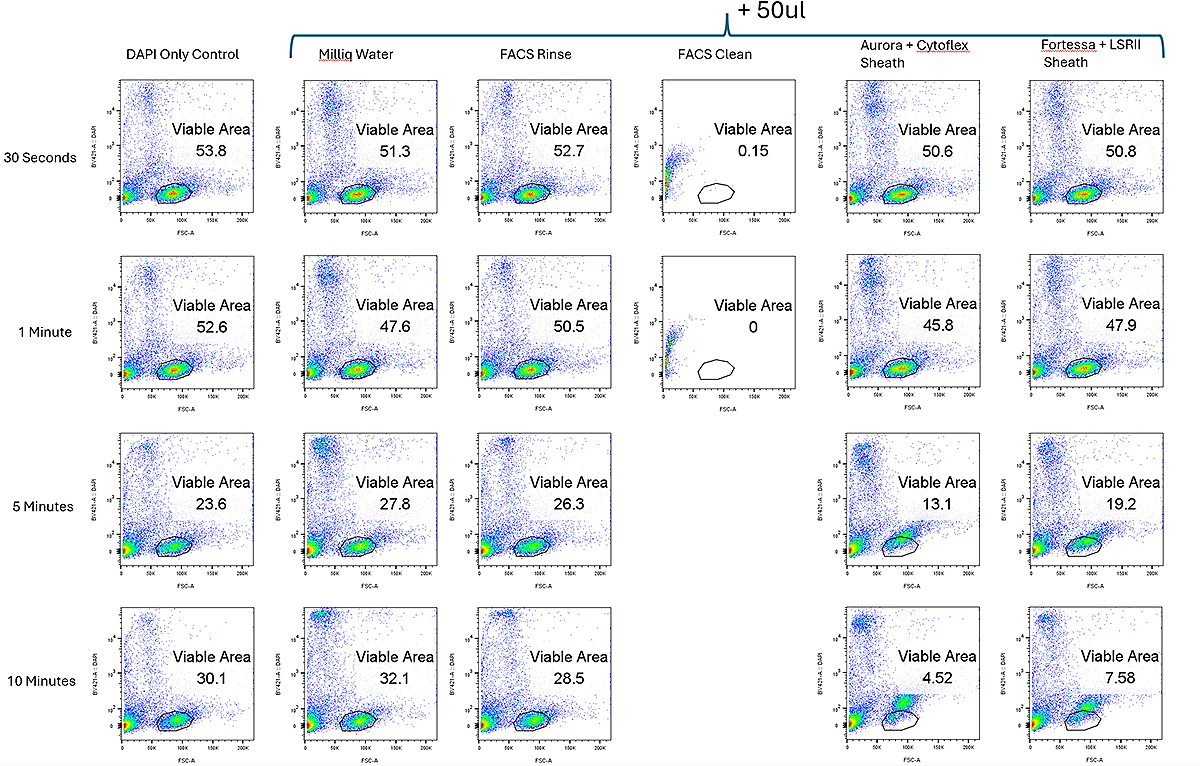
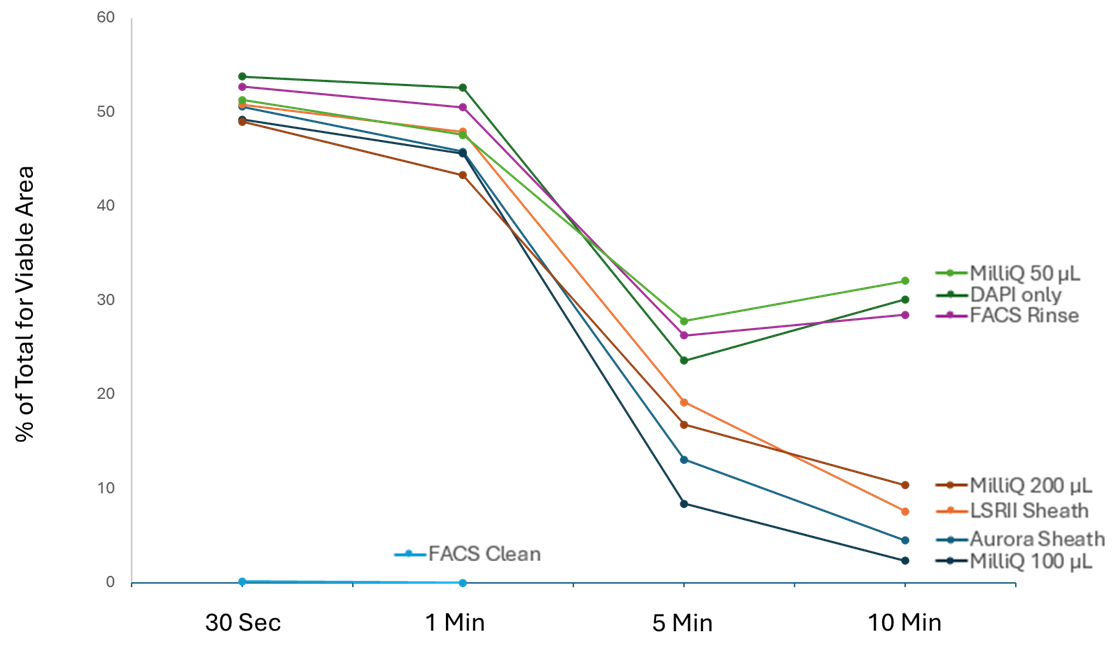
To better understand this, we ran a small test with splenocytes kindly donated by the Held Lab. We added 50 μL of each cleaning solution (used by our machines), along with both types of sheath fluid, to 500,000 cells suspended in 100 μL. We then assessed viability using DAPI at four time points: 30 seconds, 1 minute, 5 minutes, and 10 minutes.
|
Our sheath fluids that we make in house are:
|
Aurora & CytoFLEX: MilliQ water with Phenoxyethanol (as a surfactant).
|
|
LSRII and Fortessa: MilliQ water with Phenoxyethanol and 0.25x PBS for 20L, the PBS serving as a conductor to trigger the waste probe when full.
|
|
|
|
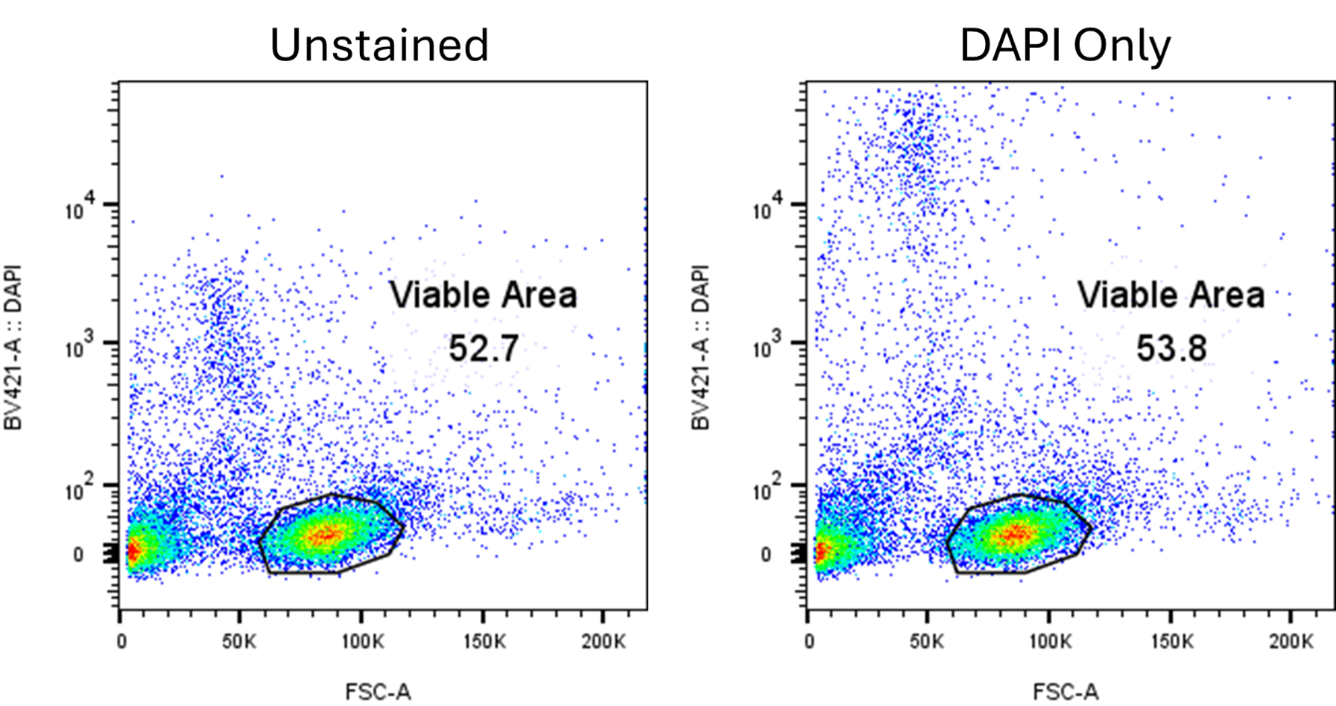
Viability was defined as the percentage of total events that were DAPI-negative and retained their forward scatter (FSC) integrity, excluding both dead cells and degraded debris.
|
|
|
FACS Clean (bleach) was as lethal as expected, completely wiping out cells within 1 minute. We didn’t test it further.
|
|
MilliQ water, surprisingly, had little impact when added at 50 μL volumes. Its effect on viability only became significant when volumes increased to 100 μL and 200 μL. This suggests that small accidental amounts might not be as harmful as assumed, though caution is still warranted.
|
|

|
FACS Rinse (detergent), despite being the first step in the BD cleaning cycle and similar in effect to a permeabilizing agent, also showed minimal immediate impact at 50 μL.
|
Sheath solutions: The Fortessa and LSRII sheath performed slightly better than Aurora/CytoFLEX sheath potentially due to its added PBS. However, neither matched the control sample in viability, indicating even properly formulated sheath can negatively affect cells if introduced directly and allowed to sit for extended periods of time.
|
|
It’s worth noting that under normal analyzer operation, sheath fluid should never mix with your sample due to laminar flow and differential pressure, so these scenarios reflect only contamination events not typical use. Unless you’re sorting in which case the collection tube will include the sheath droplets cells are encased in. However our sheath buffer for our sorters is balanced for osmolarity, but it is still advisable to precoat collection tubes with a proper collection buffer already with FBS or your preferred buffer.
|
|
|
Overall, besides the FACS Clean bleach, the solutions added didn’t drastically impact viability within the first minute, however by 5 minutes of sitting at room temperature viability began to drop across all samples. While this did stabilize by the 10 minute mark, they were all much lower than at their first minute of being run. This could suggest that if you have a very large sample to run, it could be better to run it broken up across multiple tubes that stay on ice and then just append/concatenate the FCS file afterwards.
|
|
If you have any additional questions or comments about the cleaning solutions or if you think there’s something we’ve missed or should try again for this test, such as fluorescence stability make sure to reach out to the FCF team for support.
|
|
|
|
|