|
|

|
|
|
|
|
|
|
Facility News
We're finally hitting November and as it has been happening for a while now, your male colleagues are all about their moustaches 🥸 to promote Movember and male related diseases awareness! Last month, it was Breast Cancer Awareness Month (Octobre Rose 🌷) that puts the spotlights on breast cancer treatments and prevention. Soon in December, the Telethon will be all about rare genetic diseases and funding for their treatments.
|
Now, I think it's time to talk about a real disease that has been plaguing flow cytometry for years. I am of course talking about the dreadful and chronic pathology of nosingleorcontrolosis. This affliction is hitting at random and sometimes with no potential healing options. Let's together say no to FCF users that can't produce single reference controls ! Let's join to bring the world together around properly gated populations thanks to FMO controls. Embrace the joy or undoubtful results by supporting our charity "Flow Controls for All"!
|
This month in FACS Tips, Kevin is giving you guys a master lesson on what not to do with our Aurora machines ! Please make sure to remember his advice !
|
|
Lily Jo Becker won the mug of the month below, congratulations to you ! Please come by to our office at the SE-C Biopole to pick it up !
|
|

|
Please try to answer our quiz it and get a chance to win our next mug of the month ! Good luck to you all !
|
|
|
|
|
|
FACS Tips
|
Sharing and not Caring : An adventure in Cross Machine Unmixing
|
The Aurora is, I'd argue, our most user-friendly instrument, and much of that credit goes to SpectroFlo, arguably the best instrument software we have at the facility. It easily lets you adjust, update, and alter experiments in a way that is super helpful. If a single stain isn't working? Import an FCS file to replace it. Need corrected negative controls? Export and import unstained or negative cells. There is a tremendous flexibility and adaptability to the Aurora setup that helps get the most out of your data.
|
But there's a flip side: that same user-friendliness can make inadvisable things look possible.
|
A rule that Cytek has insisted we stick to is that users should not take single stains recorded on one machine, and import them into another. But, with our 6 Aurora instruments, it can be overwhelmingly tempting to do this. Maybe not for a whole panel, but even just for a couple markers. And it's easy to see why it would make sense to do this, after all, they’re in theory the same machines in terms of their lasers and detectors, running on the same software, and being QC’ed with the sample bead lot. So, what’s the problem with this?
|
Thanks to an ongoing Aurora Standardization project we have taken on in the facility, the fruits of which we look forward to sharing in the not-so-distant future, I can show you how it looks to unmix samples from multiple instruments from single stains recorded on just one instrument.
|
For this test, we ran the same 16-colour panel sample, with the same single stains, on all six Aurora instruments on the same day, after QC with the same beads. The sample was a lyophilized PBMC demo plate, so stability and standardization were guaranteed.
|
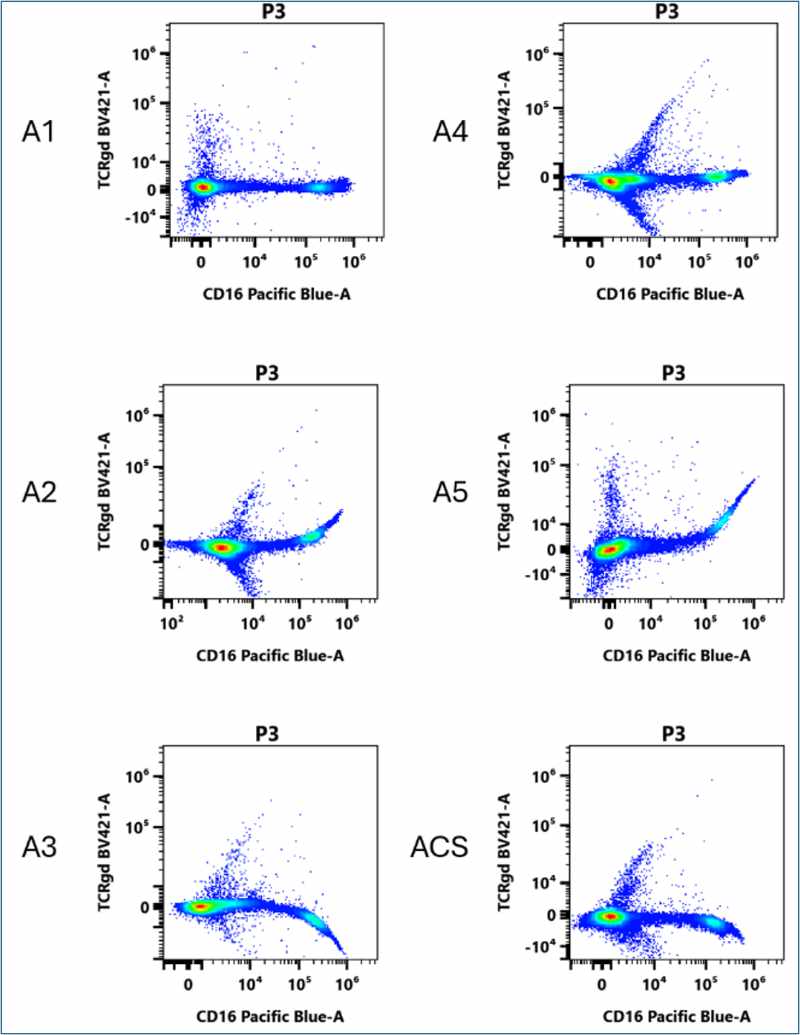
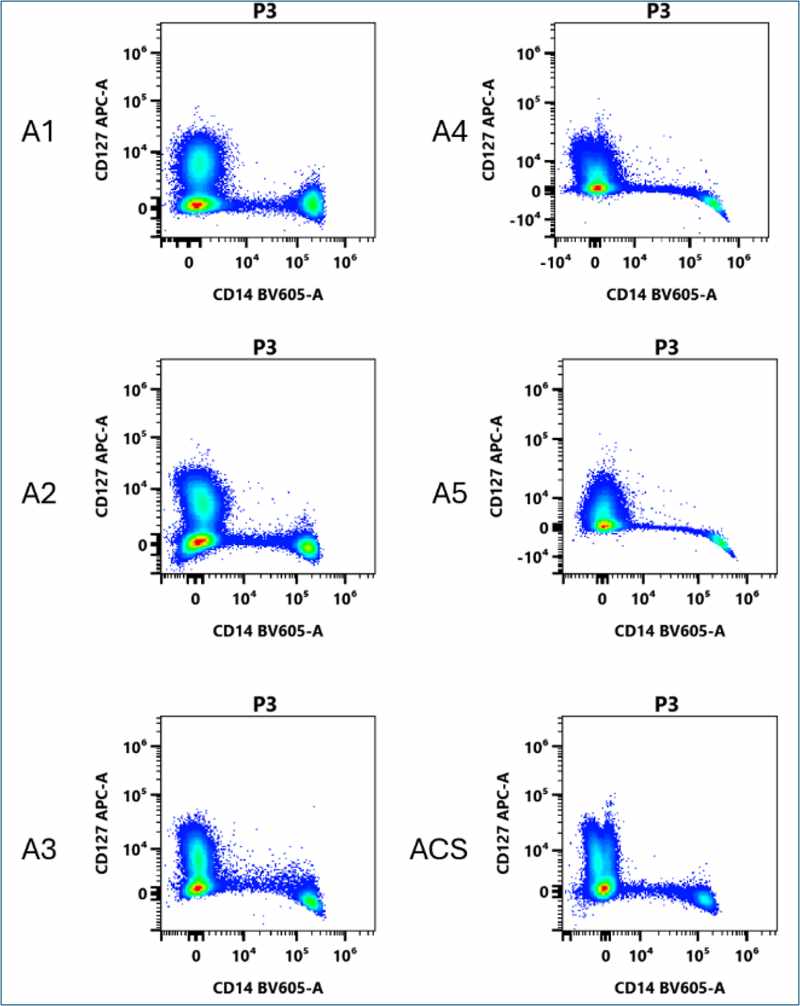
For this analysis, I took the single stains recorded from Aurora 1, generated an unmixing matrix, and applied it to that same fully stained sample run on Aurora 1 to 5 and the Aurora Cell Sorter (ACS). As you would expect, the NxN matrix for the Aurora 1 sample looks good, with few unmixing errors, but this does not hold for the other instruments.
|
|
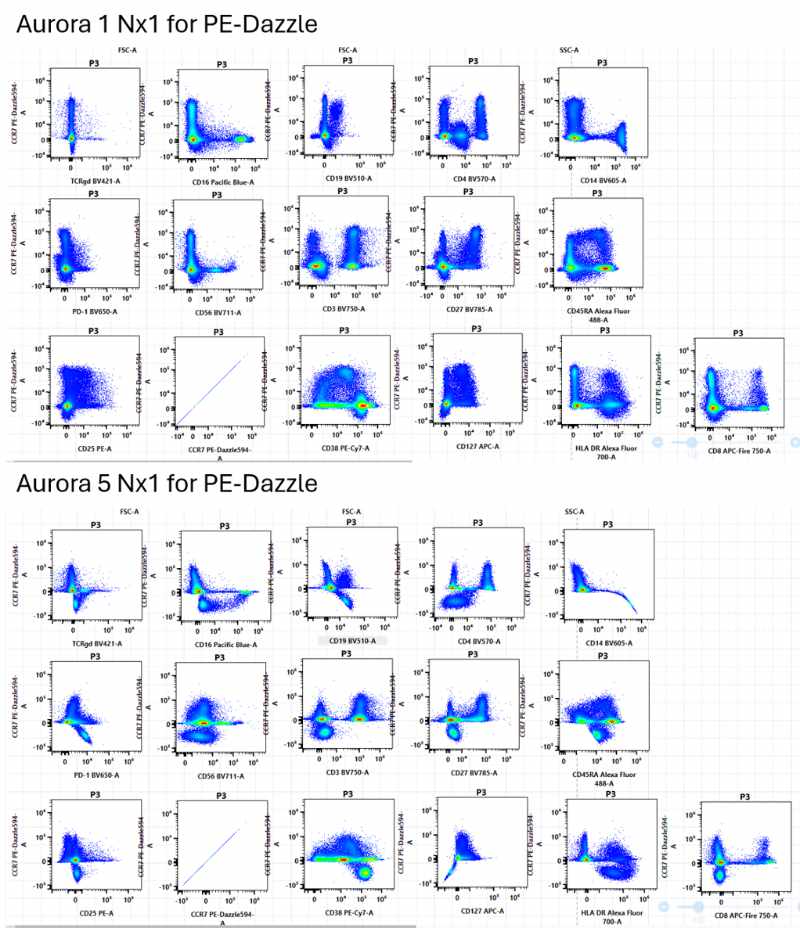
After doing an Nx1 for each of the machines, it becomes clear that the Aurora 1 single stains don’t quite unmix as well as other instruments.
|
|
|
|
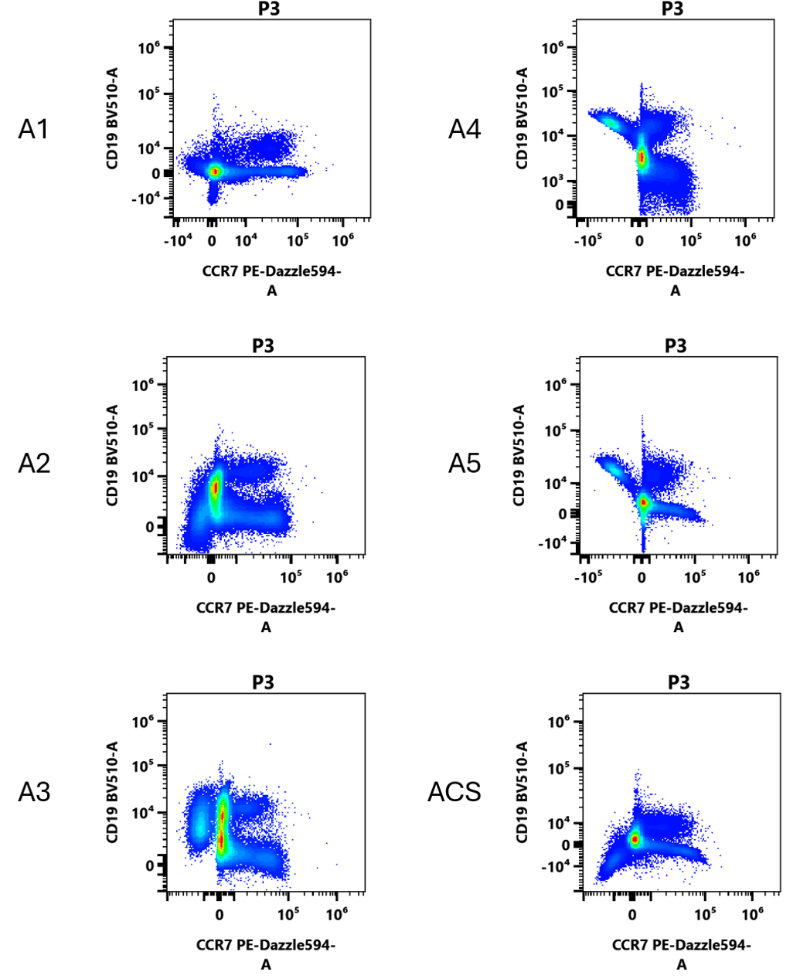
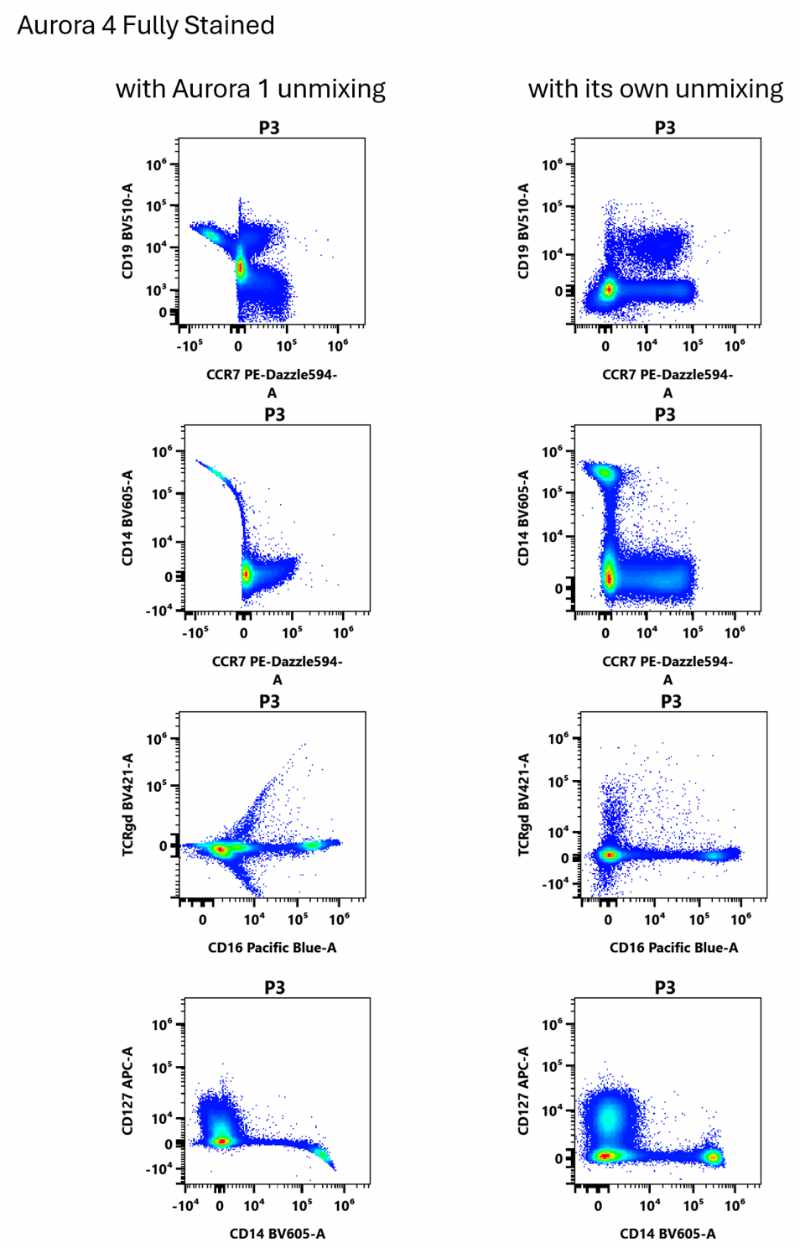
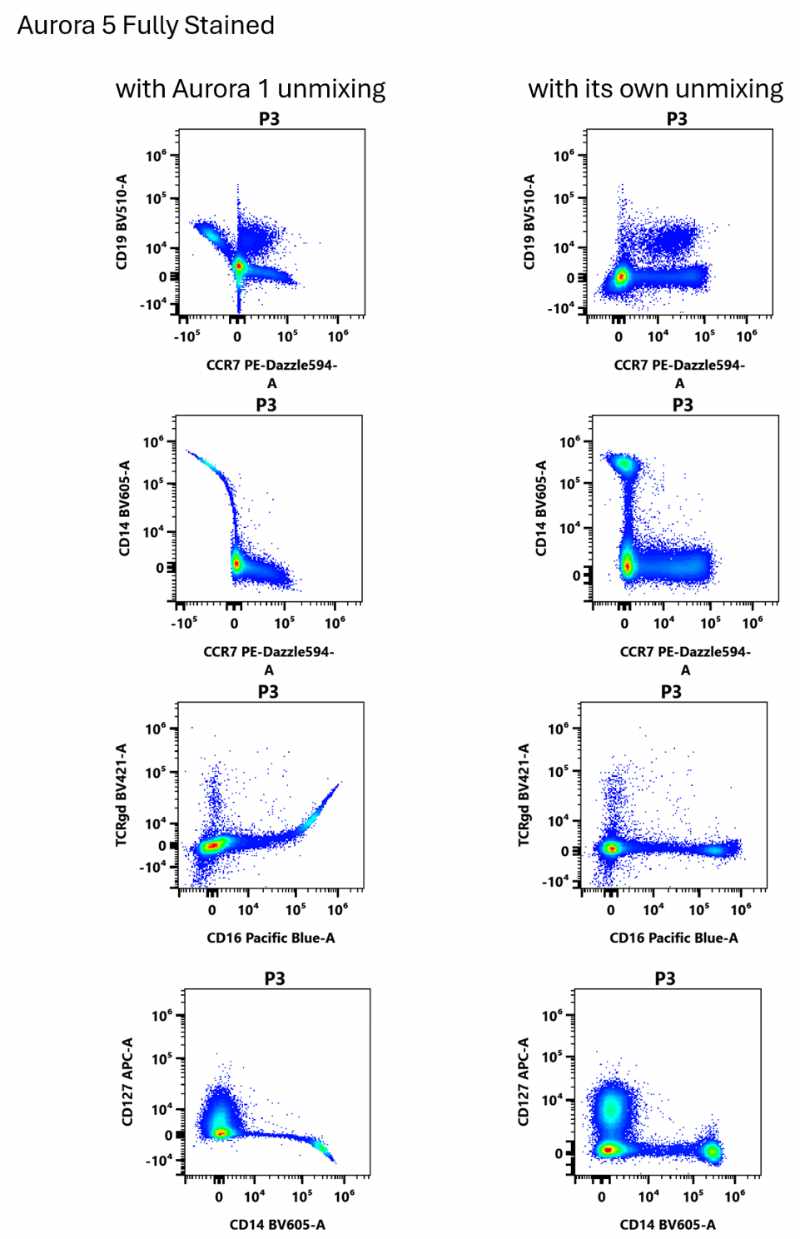
For BV510 (Y axis) by PE-Dazzle 594 (X axis), there is an obvious super negative unmixing issue with a hard 45° angle for the Aurora 4 and 5.
|
|
|
|
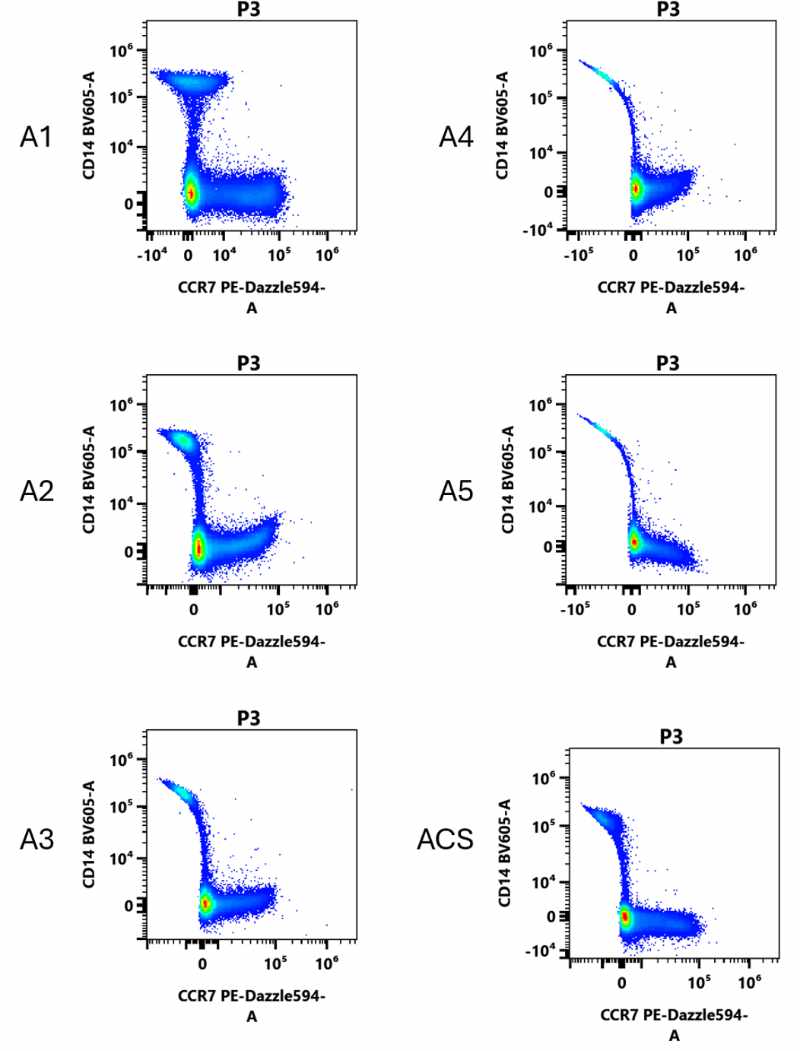
For BV605 (Y axis) by PE-Dazzle 594 (X axis), while the Aurora 1 single positive population for BV605 has some spreading it looks quite good, however we saw an overmixing error in all other Auroras. Again, this is most noticeable in Aurora 4 and 5.
|
|
|
|
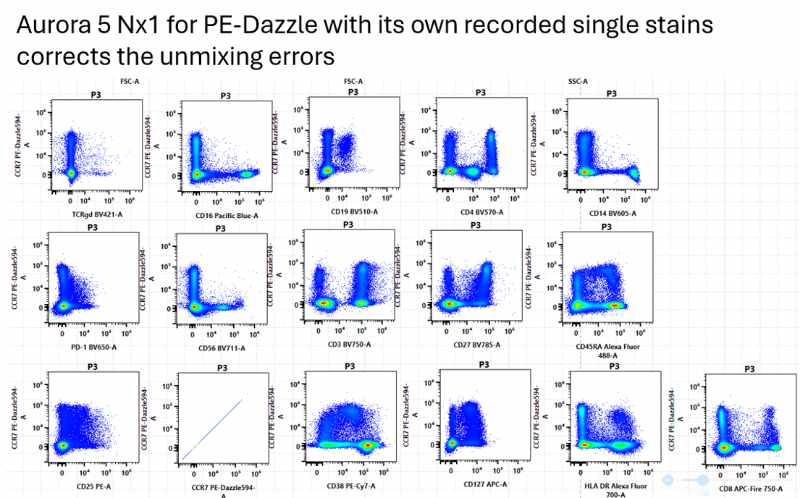
Overall, the PE-Dazzle seemed to have the largest number of unmixing problems across the machines with the Aurora 1 unmixing matrix applied. This was immediately corrected as you will see below when each machine had its own unmixing applied (Aurora 5 as an example).
|
|
|
|
I also saw similar issues with BV421 (Y axis) by Pacific Blue (X axis) and APC (Y axis) by BV605 (X axis), also generating unmixing errors across other instruments.
|
|
|
|
|
To prove that these issues are due to the unmixing singles coming from the wrong machines, if I correctly unmixed each fully stained sample with its own recorded single stains (again these are the identical single stains, just run on each machine), these unmixing errors vanish. The data looked correct again.
|
|
|
|
Interestingly, the biggest errors seemed to be found on the Aurora 4 and 5, which are our new Aurora EVO instruments. Why specifically they seem to get more dramatic issues I can’t be sure, but they do have slightly different fluidics.
|
To be clear, there are an infinite number of ways that I could have combined and rearranged these 16 single stains across 6 instruments. It’s possible I could still resolve a decent unmixing with a Frankenstein like panel of single stain pieces from multiple instruments strung together. But much like Frankenstein, the unchecked ambition and ignorance for the consequences of a scientist created a monster. This could spell the same for your Aurora data if you too try and stick endless pieces together across all our machines.
|
|
Our facility advice would be to run all your single stains on each instrument you plan to use, and to avoid at all costs transferring single stains recorded on one machine to another, despite how easy SpectroFlo may make it to do. For any advice with your spectral experiments come ask us at the FCF.
|
|
|
|
|