New Paper Published : Revisiting the morphological method in two?dimensions to quantify bed?material transport in braided rivers

Antoniazza, G., Bakker, M., and Lane, S. N. ( 2019) Revisiting the morphological method in two?dimensions to quantify bed?material transport in braided rivers. Earth Surf. Process. Landforms, 44: 22512267

Research in the 1990s showed that bed?material transport rates could be estimated at the reach scale in both one?dimension and, over small spatial scales (10s of m), in two?dimensions. The limit on the latter was the spatial scale over which it was possible to obtain distributed data on morphological change. Here, we revisit the morphological method given progress in both topographical data acquisition and hydraulic modelling. The bed?material transport needed to conserve mass is calculated in both one and two dimensions for a 1600?m?×?300?m Alpine braided river “laboratory”. High?resolution topographical data were acquired by laser scanning to quantify Digital Elevation Models (DEMs), and morphological changes caused by the flushing of the water intake were derived from repeated surveys. Based on DEMs of differences, 1D bed?material transport rates were calculated using the morphological method. Then, a 2D hydraulic model was combined with a topographic correction to route sediment through the network of braided channels and to obtain a spatially variable estimate of transport in both downstream and cross?stream directions. Monte Carlo simulation was applied to the routing model parameters, allowing identification of the most probable parameter values needed to minimize negative transport. The results show that within?section spatial compensation of erosion and deposition using the 1D treatment leads to substantial local errors in transport rate estimates, to a degree related to braiding intensity. Even though the 2D application showed that a large proportion of the total transport was actually concentrated into one main channel during the studied low flow event, the proportion of transport in secondary anabranches is substantial when the river starts braiding. Investigations of the effects of DEM resolution, competent flow duration and survey frequency related to ‘travelling bedload’ and sequential erosion?deposition emphasized the critical importance of careful data collection in the application of the morphological method.

A copy is available here.


New publication: Climate?driven change in the water sourced by trees in a deglaciating proglacial forefield, Torres del Paine, Chile

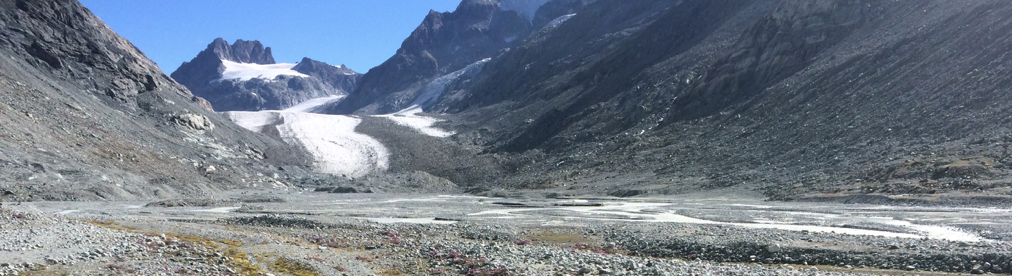
The colonization of proglacial margins by vegetation following glacier recession is a slow process, not least because glacially produced sediments are commonly well drained. Following from human?induced climate change, warming could increase both growth rates and water availability because of glacier melting, so compensating for situations where climate change reduces precipitation. Compensation is likely a function of location, which will control access to meltwater and groundwater, themselves spatially variable. For the Olguin glacier (Torres del Paine, Chile), we test the hypothesis that as climate has warmed and precipitation has fallen, tree growth rate response is dependent upon the access of trees to glacial meltwater. Cores were taken from trees in three revegetating zones: (Z1) proglacial stream proximal, (Z3) proglacial stream distal, and (Z2) intermediate between Z1 and Z3. For trees within each zone, we measured annual tree?ring widths and ?2H values. Z1 growth rates were strongly correlated with temperature and Z3 with precipitation, and Z2 showed a shift from precipitation correlation (i.e., following Z3) to temperature correlation (i.e., following Z1) through time. ?2H values were lowest at Z1, reflecting water of glacial origin, were highest at Z3, reflecting meteoric water supply, and shifted through time at Z2 from meteoric to glacial. Increased water supply associated with temperature?driven glacier recession may compensate for decreasing water supply from precipitation to influence tree growth. This compensation is likely related to the spatial organization of the subsurface flux of glacial melt and leads to different revegetation processes to those envisaged in the classical chronosequence model of vegetation following glacier recession.

The paper has been published in Ecohydrology and a copy is available here.

New Paper Published: Making stratigraphy in the Anthropocene: climate change impacts and economic conditions controlling the supply of sediment to Lake Geneva

The Anthropocene has been proposed as a profound, globally synchronous rupture in the history of the Earth System with its current state fundamentally different to that of the Holocene and driven by the geological force of human activity. Here, we show how stratigraphy is being made in a lake that is heavily impacted upon by climate change and human activities. For one of the largest inner-Alpine catchments in the European Alps, we draw attention to how sedimentation rates are a product of non-stationary, reflexive, human actions. In Lake Geneva, we identify both a human-induced climate change (HCC) signature and the effects of a recent economic shock on sediment extraction upon sediment loading to and sedimentation rates in the lake. The HCC signature thus reflects the nature of climate change impacts in this basin, where sediment accumulation rates evolve with climate, but where economic conditions contribute to shifts in the supply of sediment to the lake. Following social theory, we call this glocalization because of the combined importance and inseparability of human impacts across different spatial scales. The nature of human impacts on sediment delivery to the lake mean that the influence of humans is unlikely to be captured in the long-term depositional record.

The paper can be obtained here. The paper was picked up by a number of local media sites, (1), (2), (3) and (4).

New Paper Published : A framework for using small Unmanned Aircraft Systems (sUASs) and SfM photogrammetry to detect salmonid redds

Salmonid populations are widely distributed globally and are of economic, cultural and ecological importance. Evidence suggests that they are in decline in many parts of the world and one of a number of hypotheses for their decline is the degradation of spawning habitat. Knowledge of spawning sites and their evolution through time is a means of estimating regional population dynamics and sizes. Traditionally, spawning sites have been identified visually. However, this may not allow a precise quantification of the real extent of salmonid reproduction and of its evolution through time (i.e. within the spawning season). This paper develops a framework for using small Unmanned Aircraft Systems (sUASs) and Structure from Motion (SfM) photogrammetry to detect salmonid redds, the nests that are the distinctive footprint of spawning, through analysis of inter-epoch Digital Elevation Models (i.e. DEMs of Difference). SfM-derived DEMs of Difference are an effective tool to investigate spawning because of the distinctive ellipsoidal erosion-deposition pattern of salmonid redds, which discriminates them from other stream-bed elevation changes. The method detects more redds (e.g. those covered by algae or biofilm) compared with classical visual observation, allowing for a better and more rigorous detection of spawning grounds. SfM photogrammetry also provides additional information relevant to understanding salmonid spawning, including redd-density and probable female lengths, without disturbance of the spawning sites.

This paper has been published in Ecological Indicators and can be accessed here.

Dr. Nico Bätz awarded Dick Chorley Medal and Prize

Nico Bätz has been awarded the 2019 Dick Chorley Medal and Prize by the British Society for Geomorphology. The award is for an outstanding research paper first authored by an early career researcher. Nico received the award for the paper:

Bätz, N., Cherubini, P., Colombini, P. and Lane, S.N., 2016. Groundwater controls on biogeomorphic succession and river channel morphodynamics. Journal of Geophysical Research – Earth Surface, 121, 1763–1785

New Paper Published : Morphological response of an Alpine braided reach to sediment-laden flow events

Bakker, M., Antoniazza, G., Odermatt, M. and Lane, S.N., 2019. Morphological response of an Alpine braided reach to sediment-laden flow events. Journal of Geophysical Research – Earth Surface, 124, 1310-28.

Braided gravel?bed rivers show characteristic temporal and spatial variability in morphological change and bedload transport under steady flow and sediment supply rates. Their morphodynamic behavior and long?term evolution in response to nonstationary external forcing is less well known. We studied daily morphological changes in a well?constrained reach of an Alpine braided river that is subject to regulated sediment?laden flows, associated with hydroelectric power exploitation, as well as occasional floods. We found that net reach erosion and deposition were forced by upstream sediment supply, albeit in a nonlinear fashion. The spatial distribution of morphological change and inferred spatially?distributed sediment transport rates varied strongly along the braided reach and between successive sequences of flushing. Local morphological change was driven by two factors: (1) local relief, leading to the preferential filling of topographic lows and erosion of highs, particularly during longer duration floods, which allow braided dynamics to be maintained; and (2) system memory, leading to a negative autocorrelation in bed level changes where erosion was followed by deposition of similar magnitude and vice versa. This effect was associated with the temporary storage of high sediment loads from flushing due to the abrupt on?off nature of these flows and reveals the relatively efficient transport of sediment in a river that is heavily impacted upon by flow abstraction. In general, the internal morphodynamics of the braided river condition their own response to external forcing events and thus sediment transfer.

A copy of the paper can be accessed here.

New data made freely available

We have recently made lots of our data newly available in open access format. All the data can be accessed here : These data include

  1. 15 minute resolution normalized hydrographs for 6 glaciated basins in south-west Switzerland (search on: Q_1969_2014)
  2. Long-term digital elevation models of the Borgne d’Arolla reconstructed from aerial imagery and starting in the 1960s. These are supported by data on flushing of sediment from two intakes (search on: Bakker M)
  3. Short-term (daily time-scale) digital elevation models of a braided river (c. 300 m wide, 1600 m long) over a three week period (search on: Bakker M)
  4. Data from a monitoring project (SNSF PNR70 Hyroenv) of macroinvertebrate life in the Borgne d’Arolla (search on: macroinvertebrate)

If you want to look for other data available (e.g. glacier recession, DEMs of hillslopes), choose “advanced search”; then unclick all boxes except “data”

New Paper Published : Decadal?Scale Climate Forcing of Alpine Glacial Hydrological Systems

Quantification of climate forcing of glacial hydrological systems at the decadal scale is rare because most measurement stations are too far downstream for glacier impacts to be clearly detected. Here we apply a measure of daily hydrograph entropy to a unique set of reliable, high?altitude gauging stations, dating from the late 1960s. We find a progressive shift to a greater number of days with diurnal discharge variation as well as more pronounced diurnal discharge amplitude. These changes were associated with the onset of rapid warming in the 1980s as well as declining end of winter snow depths as inferred from climate data. In glaciated catchments, lower winter snow depths reduce the magnitude and duration of snowpack buffering and encourage the earlier onset of glacier ice exposure, with associated lower surface albedo and more rapid melt. Together, these processes explain the increase in the observed intensity of diurnal discharge fluctuations.

The paper has been published in Water Resources Research and can be accessed here.

New paper published : Quantification of bedform dynamics and bedload sediment flux in sandy braided rivers from airborne and satellite imagery

Images from specially?commissioned aeroplane sorties (manned aerial vehicle, MAV), repeat unmanned aerial vehicle (UAV) surveys, and Planet CubeSat satellites are used to quantify dune and bar dynamics in the sandy braided South Saskatchewan River, Canada. Structure?from?Motion (SfM) techniques and application of a depth?brightness model are used to produce a series of Digital Surface Models (DSMs) at low and near?bankfull flows. A number of technical and image processing challenges are described that arise from the application of SfM in dry and submerged environments. A model for best practice is presented and analysis suggests a depth?brightness model approach can represent the different scales of bedforms present in sandy braided rivers with low?turbidity and shallow (< 2?m deep) water. The aerial imagery is used to quantify the spatial distribution of unit bar and dune migration rate in an 18?km reach and three ~1?km long reaches respectively. Dune and unit bar migration rates are highly variable in response to local variations in planform morphology. Sediment transport rates for dunes and unit bars, obtained by integrating migration rates (from UAV) with the volume of sediment moved (from DSMs using MAV imagery) show near?equivalence in sediment flux. Hence, reach?based sediment transport rate estimates can be derived from unit bar data alone. Moreover, it is shown that reasonable estimates of sediment transport rate can be made using just unit bar migration rates as measured from 2D imagery, including from satellite images, so long as informed assumptions are made regarding average bar shape and height. With recent availability of frequent, repeat satellite imagery, and the ease of undertaking repeat MAV and UAV surveys, for the first time, it may be possible to provide global estimates of bedload sediment flux for large or inaccessible low?turbidity rivers that currently have sparse information on bedload sediment transport rates.

The paper is published in Earth Surface Processes and Landforms and can be accessed here.