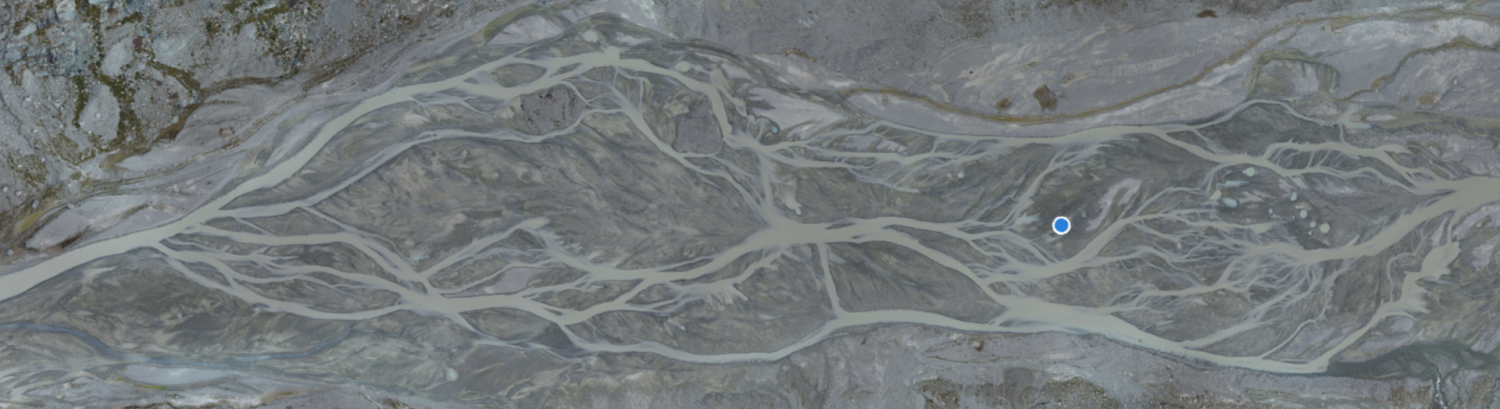
It is well established that changes in climatic conditions across Alpine environments have influenced tree-growth at altitudes close to the tree line. Less well known is the impact that increasing proportions of glacial melt water, which may accompany increasing temperatures and otherwise drier conditions during warmer summers, have on the tree growth along the glacial outwash rivers within the basin. In many Alpine basins in Switzerland, hydropower development further alters natural hydrological regimes by modifying runoff timing and flow composition. This study investigates the combined effects of climate variability and hydropower regulation on tree growth and isotopic compositions in the Turtmann River Basin in south-west Switzerland, where an upstream hydropower dam (2200 m a.m.s.l.) stores almost all glacial meltwater, and therefore, the riverine flow below the dam becomes increasingly dependent on snowmelt and rainfall from the unglaciated and unexploited basins. We analysed 75 years (1946–2020) of δ18O and the δ2H values in earlywood (EW) and latewood (LW) Larix decidua growing proximal and distal to the river at two sites within the Turtmann basin. The results show that tree ring growth was primarily temperature-limited at both sites, with a tendency for precipitation becoming a growth-limiting factor particularly at the downstream Site 2 in recent decades. The LW showed stronger climatic sensitivity than EW, reflecting increasingly dry summer conditions. Both δ18O and δ2H values of proximal trees are lower compared with those of the distal trees, reflecting snowmelt and summer precipitation but are not influenced by the glacial meltwaters draining from the upper catchment and/or released by the dam. These results demonstrate that tree-ring stable isotopic compositions can effectively trace changes in Alpine hydrologic regimes and provide valuable insights into how climate change and hydropower operations combine to influence water availability and tree growth dynamics in glaciated basins. A copy of the paper is freely-available here.