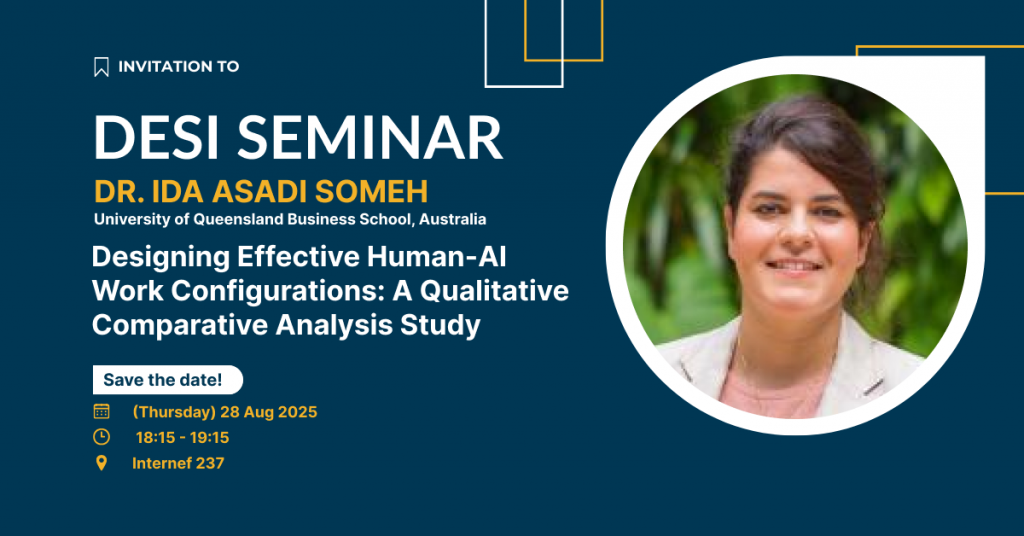
We are excited to announce that Dr. Ida Asadi Someh from University of Queensland Business School, Australia, will be delivering a seminar on Designing Effective Human-AI Work Configurations: A Qualitative Comparative Analysis Study.
Abstract: Designing effective human-AI work configurations is a prerequisite to AI implementation success. A human-AI work configuration delineates the sociotechnical design of work through which humans and AI interact, share decision-making responsibility, and coordinate work tasks. Inability to properly manage AI’s distinctive challenges such as autonomy and opacity typically results in either failed implementations or damaging outcomes from poor configurations. In this presentation, I will share on my research (currently under review) where we identify configurations of human-AI work associated with AI implementation success. To do so, we draw on 53 AI implementation projects to first identify specific conditions that constitute these configurations. Using Qualitative Comparative Analysis (QCA), we then distil these into five configurations that result in AI implementation success. Three configurations—AI Advisory, Supervised Autonomy, and Enforced AI Action— are associated with scaling up, where AI models are successfully implemented and utilized. The two— Adaptable Augmentation and Adaptable Automation— are associated with scaling out, where the models are successfully recontextualized to new domains. These findings move the body of literature on managing AI beyond the traditional dichotomy of automation and augmentation and offer actionable guidance for organizations seeking to implement AI.
Short bio: Dr Ida Asadi Someh is an Associate Professor at University of Queensland Business School, Australia, investigating the multifaceted challenges posed by AI to organizations and society. With a decade-long collaboration with the MIT Sloan Center for IS Research, she has deeply studied 70+ AI case studies globally, uncovering how leaders manage the nuanced complexities of autonomous and opaque AI systems and deliver solutions that benefit diverse stakeholders. Her publications have been recognized with numerous prestigious awards, including Top Publication Award of the Information Systems field, Best Case Study award from the Society for Information Management, and recognition for one of the most thought-provoking articles on the ethics of big data. She wants to use her insider knowledge of how AI solutions work to educate and empower consumers around the world to make better choices and exercise greater control over how AI impacts their lives. Recently, she has developed a master program focused on educating every business professional in data.