
We held the third annual meeting with the participation of members and officials from the Fundación Santa Fe de Bogotá, the Department of Social Prosperity, and the University of Lausanne (Switzerland); as well as key advisors from the University of Toronto and King’s College London.
This event took place in Bogotá, Colombia between August 12 and 15, 2025, together with project members. During these days, key topics for the development of the project were addressed, including scalability proposals, preliminary results, academic publications, topics related to the Latin American Group on Mental Health Policy and Social Policy, the work plan, and the next steps of the project.
On August 15, the event closed with the symposium “Connecting Public Policy, Digital Strategies, and Peer Support to Care for University Mental Health”, which aimed to share the project’s progress and preliminary results with stakeholders, as well as to exchange experiences regarding the applicability of strategies in sector public policy focused on youth mental health.
Annual Meeting
During the meeting event, the following objectives were achieved:
- Present the general activity timeline and study progress, including adjustments to vouchers, communications, and key products.
- Share the methodological design of the qualitative research on the peer and psychologist experience, with focus groups and interviews.
- Analyze scalability proposals from the three participating organizations, to adapt the digital intervention to new educational and social contexts.
- Present the preliminary results of the intervention and survey follow-up.
- Establish a regional work plan for the Latin American Group on Mental Health Policy and Impact, with alliances, laboratories, and joint products.
During the session on August 12, the overall project progress was presented, along with the updated timeline, actions to improve enrollment in Pluxee, and the planning of communication products such as newsletters, videos, and the dissemination of results to the territories. The design of the qualitative research analyzing the experience and accompaniment of peers and psychologists was shared.
Three proposals to scale up the intervention were also presented, one from each organization. Although the vote favored FSFB, the team highlighted the importance of strengthening sustainability, institutional coordination, and the intersectoral approach. It was agreed to maintain the educational focus, design clear work packages, and strengthen measurement and evaluation processes.
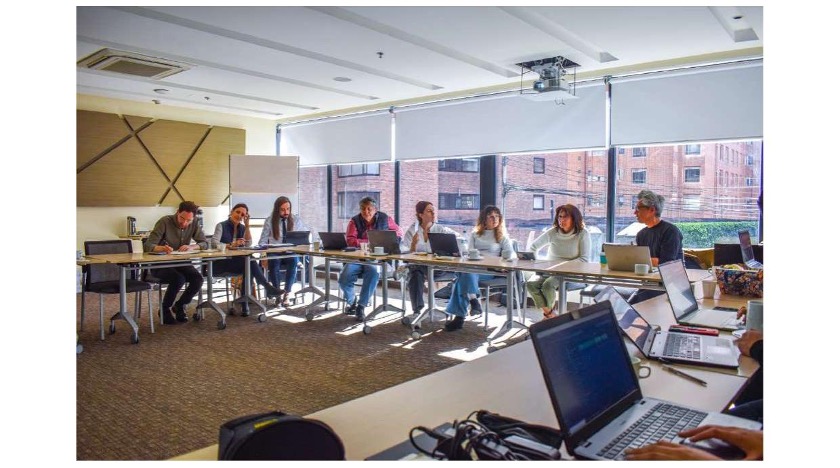
In the session on August 13, the results of the first survey follow-up and the descriptive analysis of the Renta Joven population were presented. A survey response rate with greater participation in the control group was observed. A high prevalence of mental health problems was also noted, associated with financial insecurity and experiences of armed conflict.
Preliminary results were discussed regarding slight reductions in depression and anxiety. It was concluded that usage intensity is key to impact, and strengthening contact and follow-up strategies was recommended. Regarding academic publications, two papers will be developed: one focused on the quantitative analysis of engagement and another on its qualitative dimension. The presence of psychologists was key for moderation and risk management, and potential was identified for universities, supported by artificial intelligence, to take on this role in the future.
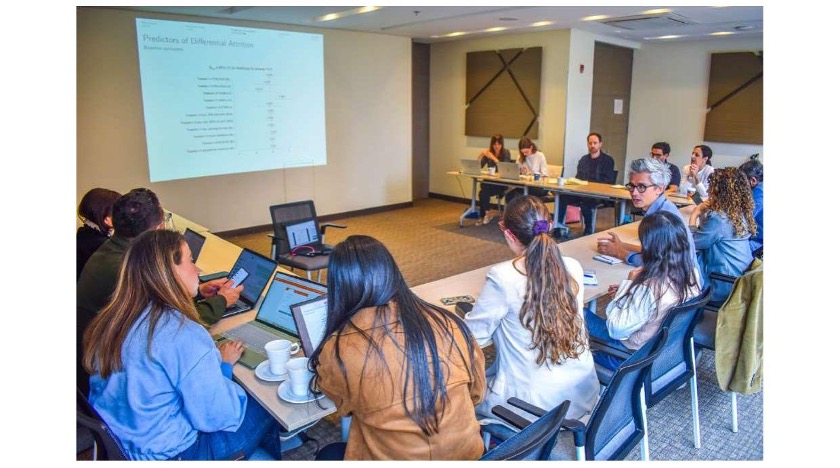
In the session on August 14, the work plan of the Latin American Political Impact Group was presented, focused on integrating mental health into social protection programs through regional alliances, stakeholder mapping, and the development of national action plans. Strategic guidelines were agreed upon: strengthening international outreach, presenting the BienEstar Joven platform as a potential tool, and mapping interest routes with each country to adjust collaboration according to context.
In addition, the communications strategy was reviewed and it was proposed to maintain unified messages oriented toward a collective purpose, with personalized follow-up and the use of varied formats. Finally, it was agreed to conduct a cost-utility analysis and complement it with a cost-benefit analysis from a social perspective.
Meeting Conclusions
• The three scalability proposals are viable, but sustainability, the intersectional approach, and institutional coordination need to be strengthened.
• The digital intervention shows reductions in anxiety and depression symptoms, with greater impact among frequent users of the platform.
• Communication must be simple, coherent, and unified for both groups, reinforcing the collective purpose and motivation.
• It was agreed to conduct cost-utility and cost-benefit analyses to evaluate the efficiency of the model and its potential scalability.
• The experience of peers and psychologists provides key learnings for future adaptations and implementation in public policies.
Symposium
During the event, the following objectives were achieved:
- Explore the relationship between youth, education, and mental health: Through the experience of the Renta Joven program, the aim is to understand how emotional well-being impacts the educational aspirations and conditions of young people.
- Present the BienEstar Joven youth mental health care platform, which integrates well-being, education, and psychosocial support.
- Analyze public policy frameworks to strengthen mental health with emphasis on the new mental health policy in Colombia and the importance of social and psychological security in youth well-being.
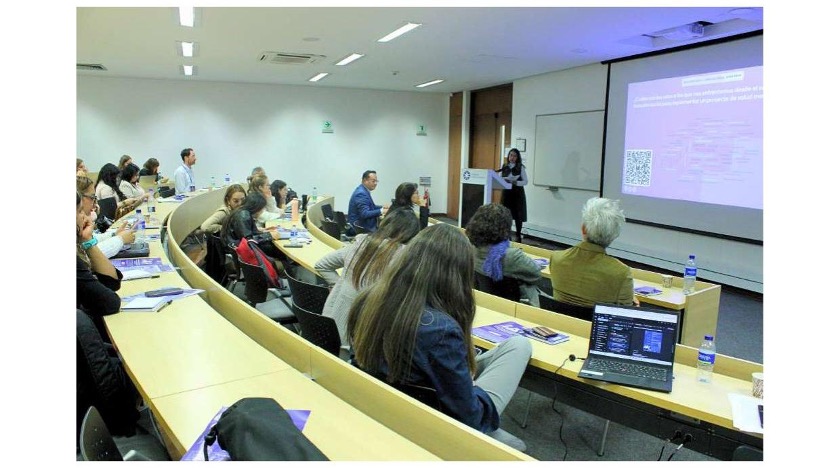
Key highlights from the symposium
- 85% of young people show symptoms of depression, anxiety, or post-traumatic stress, more frequently in women and gender-diverse youth.
- The BienEstar Joven platform reduced symptoms of depression and anxiety, demonstrating the positive impact of the digital intervention.
- The learnings highlight the importance of creating inter-institutional and international exchange spaces and greater receptiveness in the territories.
- Mental health policy shifts from a clinical-individual approach to a community-based one, with cross-sectoral actions based on social determinants of health. One notable element is the training of community managers for territories with access barriers.
- Wellness programs with a cognitive-behavioral approach are proposed, such as BienEstar Joven, with peer support and co-creation spaces where young people participate in decisions.
Symposium Conclusions
- Standardize the training of community managers, integrate them into school and community strategies, and evaluate the impact on access and reduction of mental health problems.
- Achieve coordination with key actors and position these initiatives within the inclusion sector for their impact in the territories.
- A call for coordination, given that mental health is a right that begins in the community. This policy must reach the territories; young people are key to implementing it.
- Security is a condition for thriving and requires addressing both the psychological dimension of (in)security and external factors (violence, victimization, structural inequalities).
 Spanish
  English